



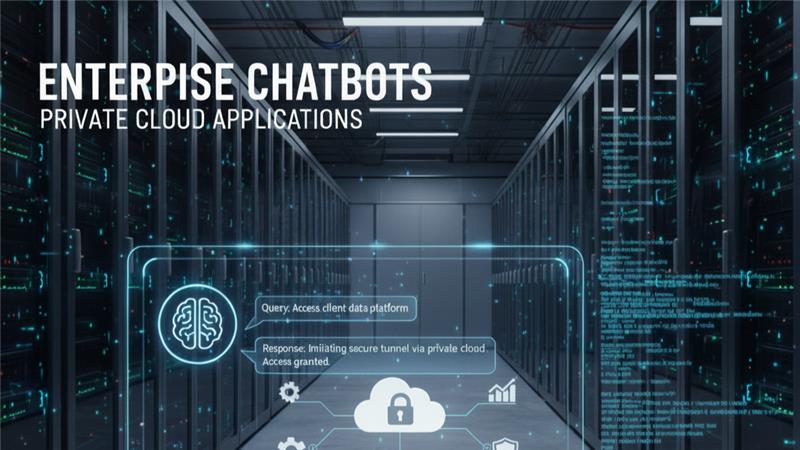
Multi-Cloud LLM Orchestration with Enterprise Data Sovereignty
Enterprise chatbots are rapidly transforming how businesses interact with customers and streamline internal processes. They offer 24/7 availability, personalized experiences, and efficient information retrieval, leading to increased customer satisfaction and reduced operational costs. This article explores the landscape of enterprise chatbot applications, focusing on practical examples from major cloud providers and LLM platforms, while highlighting SVAM’s unique multi-cloud orchestration capabilities.
What Makes an Enterprise Chatbot?
Unlike simple chatbots, enterprise-grade solutions require robust features:
- Scalability: Handling large volumes of concurrent users and requests.
- Security: Protecting sensitive data with robust authentication and authorization mechanisms.
- Integration: Connecting with existing CRM, ERP, and other business systems.
- Natural Language Understanding (NLU): Accurately interpreting user intent, even with complex language.
- Context Management: Maintaining conversation history for personalized interactions.
- Analytics and Monitoring: Tracking chatbot performance and identifying areas for improvement.
- Multi-Platform Support: Deploying across various channels like websites, mobile apps, and messaging platforms.
Cloud Platforms Powering Enterprise Chatbots
Cloud providers offer comprehensive suites of services that simplify chatbot development and deployment. Let’s explore examples from leading hyperscalers and AI platforms:
1. Microsoft Azure
Azure provides a rich ecosystem for building intelligent chatbots, leveraging services like Azure Bot Service, Cognitive Services (including Language Understanding – LUIS), and Azure Search. The Azure-Samples/azure-search-openai-demo repository provides a valuable example.
This demo showcases how to build a chatbot that leverages Azure Cognitive Search and OpenAI’s powerful language models. It demonstrates:
- Semantic Search: Using Azure Cognitive Search to retrieve relevant information from a knowledge base based on the user’s query, rather than just keyword matching.
- OpenAI Integration: Leveraging OpenAI’s models for generating natural language responses, summarizing information, and engaging in more complex conversations.
- Chat History and Context: Maintaining context across interactions for a more personalized experience.
2. Amazon Web Services (AWS)
AWS offers services like Amazon Lex (for building conversational interfaces), Amazon Comprehend (for natural language processing), and AWS Lambda (for serverless compute). The aws-samples/aws-genai-llm-chatbot repository provides a practical implementation.
This repository demonstrates how to build a chatbot using generative AI and Large Language Models (LLMs) on AWS. Key aspects include:
- LLM Integration: Connecting to LLMs like those available through Amazon Bedrock or other providers.
- Prompt Engineering: Crafting effective prompts to guide the LLM’s responses and ensure relevance.
- Retrieval Augmented Generation (RAG): Combining the power of LLMs with external knowledge bases for more accurate and informative answers.
- Serverless Deployment: Utilizing AWS Lambda for scalable and cost-effective deployment.
3. Google Cloud Platform (GCP)
GCP provides Dialogflow (for building conversational interfaces), Cloud Natural Language (for NLP), and Vertex AI (for machine learning). GCP’s approach emphasizes
- Dialogflow CX: A powerful platform for building complex conversational flows with advanced features like intent detection, entity recognition, and fulfillment.
- Vertex AI: Integrating with Vertex AI for custom machine learning models to enhance chatbot capabilities.
- Knowledge Connectors: Connecting Dialogflow to various data sources for information retrieval.
4. Anthropic Claude
Anthropic’s Claude represents a significant advancement in enterprise AI with its focus on safety, reliability, and extended context capabilities. Claude’s constitutional AI approach makes it particularly suitable for enterprise applications requiring trustworthy, predictable responses.
Key enterprise capabilities include:
- Extended Context Windows: Claude supports context windows up to 200K tokens, enabling processing of entire codebases, lengthy documents, and complex multi-turn conversations without losing context.
- Constitutional AI: Built-in safety mechanisms ensure responses align with enterprise policies and ethical guidelines, reducing risk of harmful or inappropriate outputs.
- API-First Architecture: Enterprise-ready APIs with robust rate limiting, usage tracking, and seamless integration with existing infrastructure.
- Tool Use & Function Calling: Native support for connecting to enterprise systems, databases, and APIs through structured tool definitions.
- Multi-Modal Capabilities: Vision capabilities enable document analysis, image interpretation, and visual data processing for comprehensive enterprise workflows.
5. OpenAI GPT Platform
OpenAI’s GPT models (GPT-5.1, GPT-4o etc.) provide powerful foundation models for enterprise chatbot applications, with extensive ecosystem support and proven enterprise deployments.
Enterprise-ready features include:
- Azure OpenAI Service: Enterprise deployment through Microsoft Azure provides data residency, compliance certifications (SOC 2, HIPAA), and private networking capabilities.
- Assistants API: Purpose-built API for creating AI assistants with persistent threads, file handling, and code interpretation capabilities.
- Fine-Tuning: Custom model training on proprietary data enables domain-specific responses while maintaining base model capabilities.
- Function Calling: Structured output generation for reliable integration with enterprise systems and workflows.
- Embeddings & RAG: High-quality text embeddings (text-embedding-3) for semantic search and retrieval-augmented generation architectures.
LLM Orchestration with LiteLLM
Managing multiple LLM providers in enterprise environments requires a unified orchestration layer. LiteLLMprovides a powerful solution for multi-provider LLM management while ensuring enterprise chat data remains within the client’s selected hyperscaler cloud.
What is LiteLLM?
LiteLLM is an open-source Python SDK and Proxy Server (LLM Gateway) that enables organizations to call 100+ LLM APIs using a unified OpenAI-compatible format. It translates inputs across providers including Bedrock, Azure, OpenAI, VertexAI, Anthropic, Cohere, Sagemaker, HuggingFace, Replicate, and Groq.
Key Enterprise Capabilities
- Unified API Interface: Call any LLM provider using the standard OpenAI format, simplifying application development and reducing vendor lock-in.
- Proxy Server (LLM Gateway): Centralized gateway for managing LLM access with 8ms P95 latency at 1,000 RPS, enabling high-performance enterprise deployments.
- Budget & Rate Limiting: Set spending limits and rate controls per project, API key, or model to manage costs and ensure fair resource allocation.
- Retry/Fallback Logic: Automatic failover across multiple deployments (e.g., Azure to OpenAI) ensures high availability and resilience.
- Observability Integration: Pre-built callbacks for Langfuse, MLflow, Lunary, DynamoDB, and other monitoring platforms.
- Key Management: Virtual key generation with expiration, model access controls, and team-based permissions via PostgreSQL backend.
Enterprise Data Sovereignty
A critical advantage of deploying LiteLLM within your infrastructure is complete data sovereignty. Enterprise chat data never leaves your selected hyperscaler cloud—whether Azure, AWS, or GCP. The LiteLLM proxy can be deployed as a containerized service within your private VPC, ensuring all conversation data, API keys, and audit logs remain under your control and comply with data residency requirements.
Why SVAM is Your Ideal Technology Partner
Selecting the right technology partner for enterprise AI initiatives is a decision that will impact your organization for years to come. SVAM International brings a unique combination of decades of enterprise technology experience, global delivery capabilities, and deep domain expertise that positions us as the partner of choice for organizations serious about AI transformation.
Decades of Enterprise Technology Excellence
With multiple decades of experience delivering enterprise technology services, SVAM has witnessed and navigated every major technology shift—from client-server architectures to web applications, from on-premises data centers to cloud computing, and now to the era of generative AI. This institutional knowledge is invaluable:
- Battle-Tested Methodologies: Our project delivery frameworks have been refined through thousands of successful enterprise implementations, minimizing risk and ensuring predictable outcomes.
- Technology Transition Expertise: We understand that AI adoption isn’t just about new tools—it’s about integrating with legacy systems, managing organizational change, and building sustainable capabilities.
- Long-Term Partnership Mindset: Many of our client relationships span over a decade because we focus on building lasting value, not just completing projects.
- Enterprise-Grade Standards: We bring the rigor expected by Fortune 500 companies—comprehensive documentation, change management, security protocols, and governance frameworks.
Global Delivery with Local Expertise
SVAM’s global presence across the United States, India, Canada, Bangladesh, and Mexico provides strategic advantages that single-location providers cannot match:
| Region | Strategic Value |
|---|---|
| United States | Headquarters and primary client engagement. Deep understanding of US regulatory requirements (HIPAA, SOX, CCPA), enterprise IT practices, and business culture. |
| India | World-class engineering talent pool with expertise in AI/ML, cloud technologies, and enterprise software development. Cost-effective scaling for large implementations. |
| Canada | North American time zone coverage with specialized expertise in financial services, healthcare, and public sector requirements including PIPEDA compliance. |
| Bangladesh | Emerging technology hub with growing AI capabilities, providing additional capacity and competitive pricing for development and support services. |
| Mexico | Nearshore advantage with US time zone alignment, bilingual capabilities for North American Spanish-speaking markets, and USMCA trade benefits. |
This global footprint enables 24/7 development and support coverage, cost optimization through strategic resourcing, and cultural and linguistic alignment with diverse client bases.
Domain Experts Who Understand Your Business
Technology expertise alone isn’t sufficient for successful enterprise AI implementations. SVAM’s consultants bring deep domain knowledge that enables us to deliver solutions aligned with industry-specific challenges, regulations, and best practices:
- Financial Services: Expertise in banking, capital markets, insurance, and fintech with understanding of regulatory frameworks (SEC, FINRA, Basel III) and risk management requirements.
- Healthcare & Life Sciences: Deep experience with HIPAA compliance, clinical workflows, EHR/EMR systems, pharmaceutical research, and healthcare payer operations.
- Government & Public Sector: Understanding of FedRAMP requirements, state/local government operations, and public sector procurement processes.
- Manufacturing & Supply Chain: Expertise in ERP integration, IoT implementations, predictive maintenance, and supply chain optimization.
- Retail & Consumer Products: Experience with omnichannel commerce, customer experience platforms, inventory management, and demand forecasting.
Why These Capabilities Matter
Enterprise AI initiatives fail at alarming rates—industry studies consistently show that 70-85% of AI projects do not deliver expected value. Understanding why the capabilities we’ve described are essential helps organizations make informed partnership decisions and set realistic expectations.
The Multi-Cloud Imperative
Organizations increasingly operate in multi-cloud environments—not by choice, but by necessity. Mergers and acquisitions bring disparate technology stacks. Different business units have established relationships with different cloud providers. Regulatory requirements may mandate specific data residency. SVAM’s multi-cloud expertise matters because:
- Avoid Vendor Lock-In: Single-cloud providers naturally recommend solutions that deepen dependency on their platform. We recommend what’s best for your business.
- Optimize Costs: Different clouds excel at different workloads. True multi-cloud architecture allows you to place workloads where they run most cost-effectively.
- Ensure Resilience: Cloud outages happen. Multi-cloud architectures with proper orchestration can failover between providers, maintaining business continuity.
- Future-Proof Investments: The AI landscape evolves rapidly. Today’s leading LLM may be tomorrow’s legacy system. Platform-agnostic architecture protects your investment.
The LLM Diversity Advantage
No single LLM excels at every task. Claude may be superior for nuanced analysis and safety-critical applications. GPT-5 might perform better for creative content generation. Open-source models offer cost advantages for high-volume, simpler tasks. SVAM’s cross-platform LLM expertise enables:
- Task-Optimized Model Selection: Match each use case to the model that performs best, rather than forcing all tasks through a single provider.
- Cost Optimization: Route simple queries to cost-effective models while reserving premium models for complex reasoning tasks.
- Risk Mitigation: Reduce dependency on any single AI provider’s availability, pricing changes, or policy modifications.
- Competitive Leverage: Maintain negotiating power with AI providers by demonstrating credible alternatives.
The Domain Expertise Difference
AI implementations without domain expertise produce technically functional systems that fail to deliver business value. Our domain experts ensure:
- Relevant Use Case Identification: We identify AI applications that address your industry’s specific pain points, not generic chatbot implementations.
- Compliance by Design: Regulatory requirements are built into solutions from the start, not retrofitted after deployment.
- Integration with Industry Systems: We understand how to connect AI capabilities with the specific enterprise systems prevalent in your industry.
- Stakeholder Communication: Our consultants speak your industry’s language, facilitating effective communication with business stakeholders, not just IT teams.
Why These Considerations Are Necessary
The considerations outlined in this document aren’t academic exercises—they address real challenges that have derailed enterprise AI initiatives. Understanding why each consideration matters helps organizations prioritize their planning and partner selection.
Data Sovereignty Is Non-Negotiable
Enterprise chat applications process sensitive information—customer data, financial records, strategic plans, intellectual property. The considerations around data sovereignty exist because:
- Regulatory Requirements: GDPR, CCPA, HIPAA, and industry-specific regulations mandate specific data handling practices. Non-compliance carries significant financial and reputational penalties.
- Competitive Protection: Conversation data may contain proprietary information. Ensuring it remains within controlled infrastructure protects competitive advantages.
- Customer Trust: Customers expect their interactions to remain private. Data breaches or unauthorized access destroy trust that takes years to rebuild.
- Audit and Accountability: Enterprises must demonstrate where data resides and who can access it. Private cloud deployment with proper controls provides this accountability.
Scalability Prevents Future Rework
The scalability considerations aren’t about handling today’s load—they’re about avoiding costly rearchitecture as adoption grows:
- Viral Adoption Patterns: Successful enterprise chatbots often experience exponential adoption growth. Systems designed for pilot scale collapse under production load.
- Cost Predictability: Without proper architecture, LLM costs can spiral unpredictably. Scalable design includes cost controls and optimization strategies.
- User Experience: Slow response times kill adoption. Scalable architecture with proper caching, load balancing, and model routing ensures consistent performance.
Integration Determines Value Realization
A chatbot that can’t connect to enterprise systems is just a novelty. The integration considerations matter because:
- Action Enablement: Users want chatbots that can do things—update records, process requests, and retrieve specific information. This requires deep integration.
- Context Richness: AI responses improve dramatically when informed by enterprise data—customer history, product catalogs, policy documents.
- Process Automation: The real ROI comes from automating workflows that span multiple systems, not just answering questions.
- Data Consistency: Integration ensures the chatbot operates with current, accurate information rather than stale or incorrect data.
Choosing the Right Partner Changes Outcomes
The technology landscape for enterprise chatbots is complex and evolving rapidly. Organizations that attempt to navigate it alone, or with partners lacking comprehensive expertise, consistently underperform. The considerations in this document represent lessons learned from successful—and unsuccessful—enterprise AI implementations. SVAM’s decades of experience, global delivery capabilities, and domain expertise position us to help you avoid the pitfalls and realize the full potential of enterprise AI.
SVAM’s Multi-Cloud Advantage
Technology Partner vs. Cloud Service Provider
While many consulting firms specialize in a single cloud ecosystem, SVAM International differentiates itself as a true multi-cloud technology partner. Our teams possess deep expertise across all major hyperscalers and LLM platforms, enabling us to architect solutions that genuinely serve your business needs rather than vendor relationships.
SVAM vs. Single-Cloud Providers
| SVAM Multi-Cloud Approach | Single-Cloud Providers |
|---|---|
| Expertise across Azure, AWS, GCP, and hybrid environments | Deep expertise limited to single cloud |
| Vendor-agnostic LLM selection (Claude, GPT, Granite, Gemini) | Recommendations biased toward partner LLMs |
| Unified orchestration via LiteLLM across providers | Siloed implementations per cloud |
| Flexible data residency—deploy where compliance requires | Limited to regions of single cloud provider |
| Cost optimization through multi-cloud arbitrage | Locked into single vendor pricing |
SVAM Enterprise AI Capabilities:
- Cross-Cloud Architecture: Design and implement chatbot solutions that leverage the best services from each cloud, such as Azure Cognitive Services for NLU combined with AWS Bedrock for foundation models.
- LLM Platform Expertise: Production deployments across Anthropic Claude, OpenAI GPT, Google Gemini, and open-source models like Llama and Mistral.
- Agentic AI Stack: Implementation of multi-agent architectures using LangChain, LlamaIndex, CrewAI, and Microsoft AutoGen for complex enterprise workflows.
- Data Sovereignty Assurance: Deployment architectures ensuring all enterprise data remains within client-controlled infrastructure, meeting GDPR, HIPAA, SOC 2, and industry-specific compliance requirements.
- Unified Observability: Centralized monitoring, cost tracking, and performance analytics across all LLM providers and cloud deployments.
Key Considerations for Enterprise Chatbot Development
- Define Clear Objectives: What problems will the chatbot solve? What are the key performance indicators (KPIs)?
- Understand Your Audience: Who will be using the chatbot? What are their needs and expectations?
- Design Conversational Flows: Plan the dialog carefully to ensure a smooth and intuitive user experience.
- Choose the Right Technology: Select the cloud platform, LLM providers, and orchestration tools that best meet your requirements.
- Plan for Data Sovereignty: Ensure your architecture keeps sensitive data within approved jurisdictions and cloud environments.
- Iterate and Improve: Continuously monitor chatbot performance and make adjustments based on user feedback.
Conclusion
Enterprise chatbots offer significant potential for businesses to improve customer service, automate tasks, and enhance productivity. By leveraging the power of cloud platforms like Azure, AWS, and GCP—combined with leading LLM providers including Anthropic Claude, OpenAI, organizations can build sophisticated and scalable chatbot solutions.
The key to success lies in choosing a technology partner with genuine multi-cloud and multi-LLM expertise. SVAM International’s of enterprise technology experience, global delivery capabilities spanning the US, India, Canada, Bangladesh, and Mexico, and deep domain expertise provide enterprises with the comprehensive partnership that single-cloud providers simply cannot match.
Our ability to architect and deploy across all major hyperscalers and AI platforms—orchestrated through tools like LiteLLM—gives you the flexibility, cost optimization, and data sovereignty controls essential for enterprise success. When you partner with SVAM, you gain access to consultants who understand not just the technology, but your industry, your regulatory environment, and your business objectives.
Remember that careful planning, a user-centric approach, and continuous improvement are crucial for successful chatbot implementation. With the right technology partner, your organization can harness the full potential of enterprise AI while maintaining complete control over your data and infrastructure.
Ready to Build Your Enterprise AI Solution?
Contact SVAM International to discuss how our multi-cloud expertise and decades of enterprise technology experience can accelerate your AI initiatives while ensuring data sovereignty and compliance.
Website: https://svam.com/services/ai/
GitHub (LiteLLM Fork): github.com/svamintgit/litellm
LinkedIn: https://www.linkedin.com/in/shantanu
Email: [email protected]
Shantanu cell phone: 1-646-659-6400